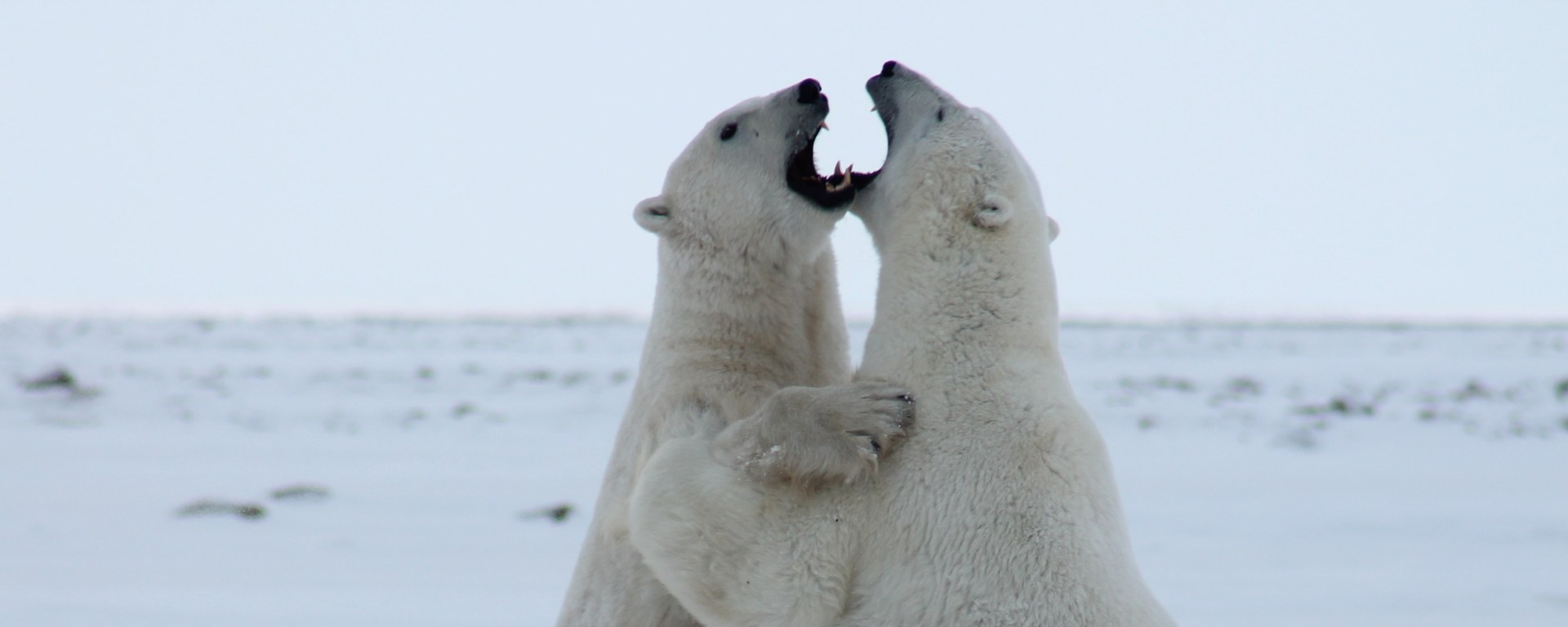
It’s quite difficult to imagine how big a male polar bear is, 3 metres (10 foot) doesn’t sort of sound much. After all Steven Adams is 2.13 metres (seven foot). But 750 Kilos (three quarters of a ton) starts to make it all sound a bit more overwhelmingly real.
Even play fighting like these young polar bears shows the terrifying power in their huge bodies. They can live up to 25 years so no doubt become bigger and more powerful every year.
Polar bears are regarded as marine mammals and are completely carnivorous, in fact the largest carnivore on the planet. They are supremely adapted to the extremely cold environment of the Arctic. Their nose is long and aerodynamically smooth for swimming – unlike a grizzly bear – the rough pads and plenty of hair on their enormous paws stop them slipping on the ice and their front paws are partially webbed allowing them to paddle comfortably at ten kilometres an hour. For days if necessary. They have been spotted 100 km out at sea.
One of the big problems facing researchers when counting polar bears from the air is that the eye doesn’t see them because of their colour and an infra red camera doesn’t pick them up. The reason for this is that the bear’s 10 cm layer of blubber, small ears, black skin and hollow, oily, clear hairs keep them so well insulated that they don’t lose any heat for an infra red camera to pick up. When a polar bear lies down on the snow to sleep, he leaves no mark or melted snow when he leaves. He loses no precious heat.
His black skin absorbs every bit of warmth around him and not only that, his seemingly white hair is actually clear and hollow allowing the formation of luminescence which gives him the white look which blends him in to the background.
Luckily for Ringed and Bearded Seals a polar bear is not fast enough to out swim them so he needs to use his very keen sense of smell to detect his dinner on the ice. Unluckily for the seals a bear can sniff them out 32 kilometres away and can smell a seal’s breathing hole from a couple of kilometres away. Also unluckily for the seals, once the bear has found the breathing hole he will sit very quietly and patiently and wait for him to unwittingly come up for air.
Polar bears have a “Feast or Famine” metabolism so that when food is scarce they are able to slow their metabolism down and live off their fat reserves in a sort of state of walking hibernation during which they don’t even urinate. But we all know about the melting ice problem which means the bears have to swim further and use up precious calories to find their prey……….
 TRAVELS PAST & PRESENT