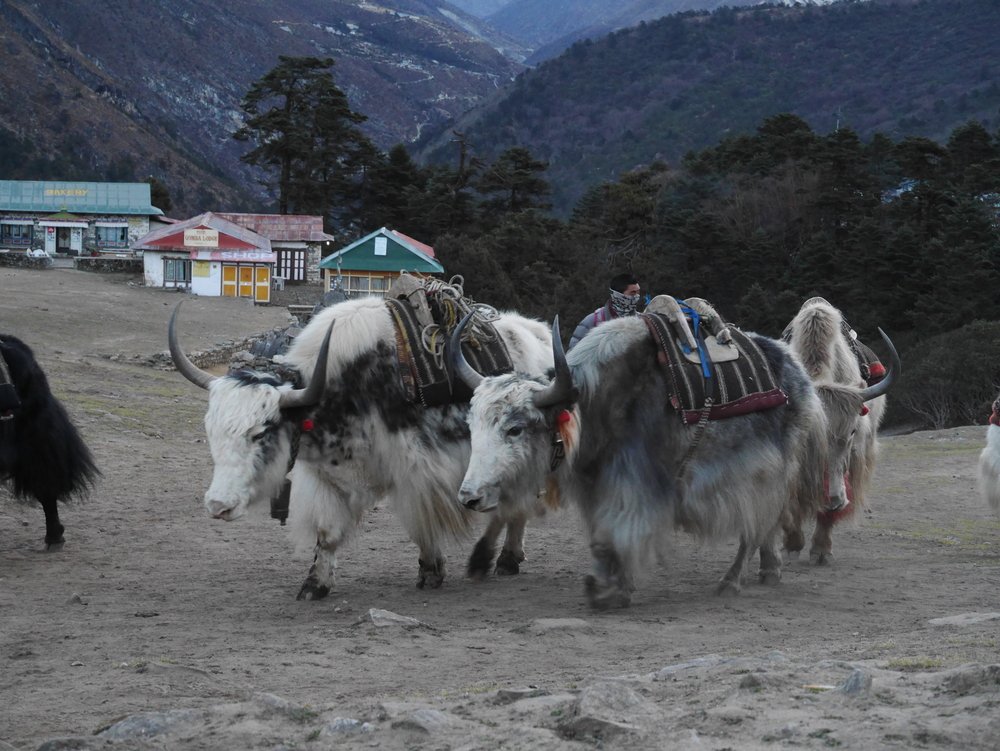
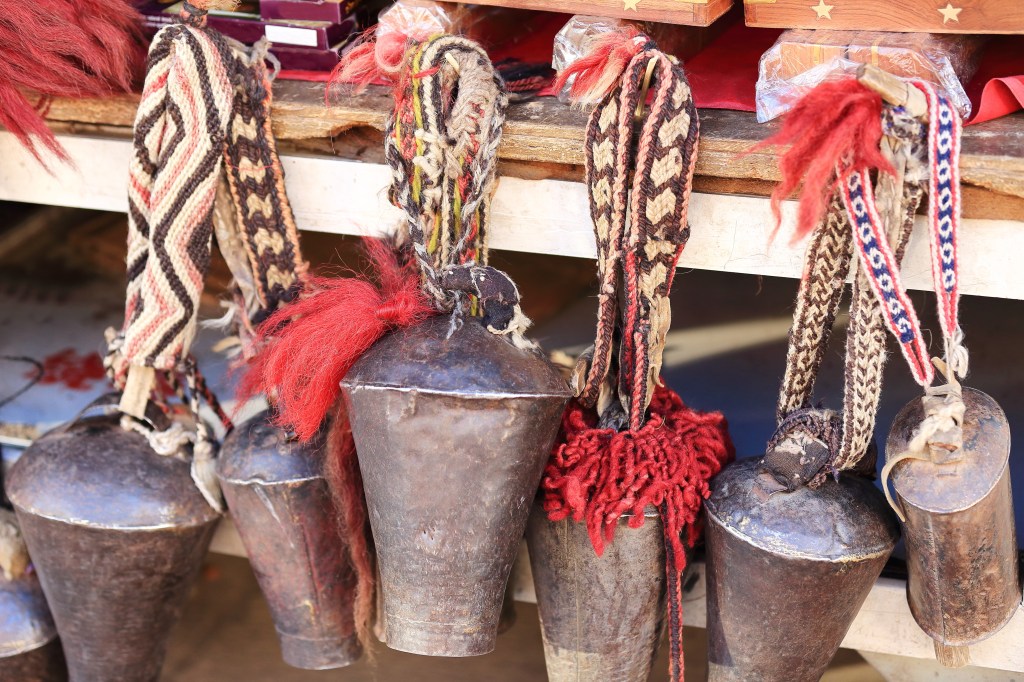
I love the gentle sound of Sherpa farmers encouraging their enormous yaks through the villages or on the trail towards Everest. The yaks wear a brass bell around their neck attached to a colourfully woven yak wool collar, the bell makes a gentle sound as if communicating with just the farmer.
The tricky part when meeting these caravans is avoiding the huge horns as the yaks swing their heads from side to side in rhythm with their walking pace. It doesn’t matter so much out in the open, but on a narrow trail or in a village with stone walls either side of the pathways, 600kgs of bell ringing , head swinging two metre spanning horns slowly but steadily coming towards you is pretty well unstoppable and you have no option but to change your route.
Because of their extra huge lung capacity – about three times that of normal cattle – their long woolly coat almost to the ground with a dense, fine undercoat and their small red blood cells which transport a lot more oxygen, yaks live only above 4,000 metres where they can withstand temperatures of – 40 Celsius.
Yaks have been used as a pack animal on the trading routes through the mountains from Tibet for hundreds of years and nowadays they also carry gear for climbing expeditions.
In the summer they are taken up to the high pastures at about 5,500 metres where the Sherpas camp and look after them, often with the help of large dogs to keep them safe from Himalayan bears. In the winter they are brought back to the village and live under the house. This means that if you visit a Sherpa house and it’s dark, you have to open the door, close it and somehow get to the stairs on the other side of the building, tripping over straw and pretending you are completely in control of your everything because animals always know if you’re fibbing. The overwhelming sense of large bovines laughing at you is all I ever remember of those moments in my life.
Yaks have always been part of every day life for Sherpas as a source of milk (a female yak is called a nak), butter, meat, wool for weaving clothes, blankets and boots, plus the dung is dried and used to fuel the fire in the house which is constantly lit for warmth, tea and cooking.
Tibetan yak butter tea is one of the special treats offered in a Sherpa house or monastery. It’s made by boiling water and then pouring it into a churn with some black tea which comes in a solid block, salt and yak butter (rancid). It’s mixed thoroughly in the wooden churn and then poured into a delicate Tibetan china bowl for you to drink.
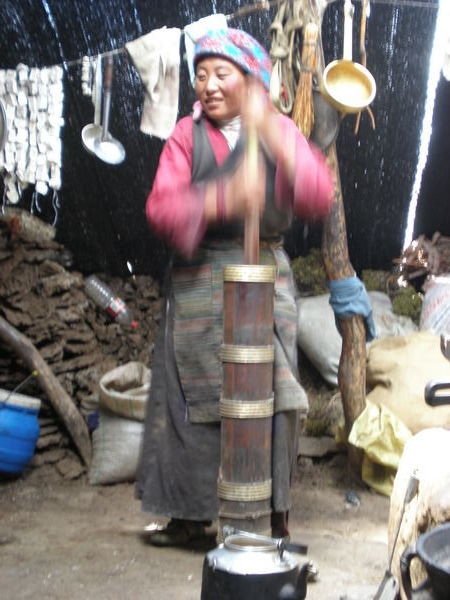
It’s a wonderful to watch and be part of this ancient ceremony, and it is possible to survive, but some people find it to be an acquired taste. Maybe it’s the rancid butter……
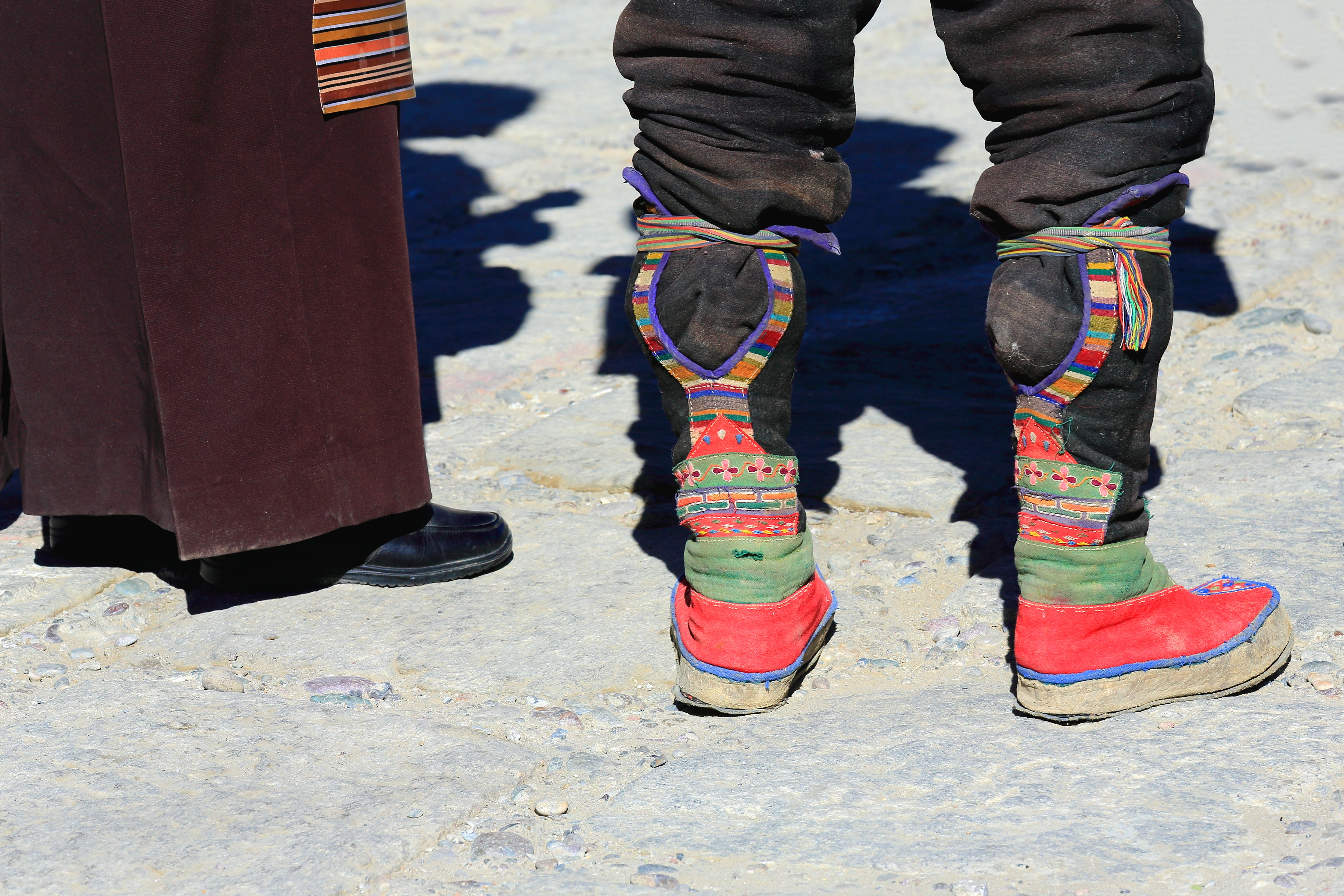
Traditional Tibetan boots have a skin sole with felted yak wool leggings decorated with embroidery and tied at the top with a woven belt. Feet are kept warm with straw stuffed and stitched tightly into the sole.
Over hundreds of years as people moved further down valley where the temperature is not as extreme, the yak was bred with local cattle which were used to the lower altitude and didn’t have quite such thick coats. The male of these crossbreeds is a zopkio (pronounced subjock) and the female a zhum. They tend to be more powerful and good milk and meat producers and have therefore become very popular. Like a mule, the male is sterile and the female is bred with purebred yaks.
 TRAVELS PAST & PRESENT