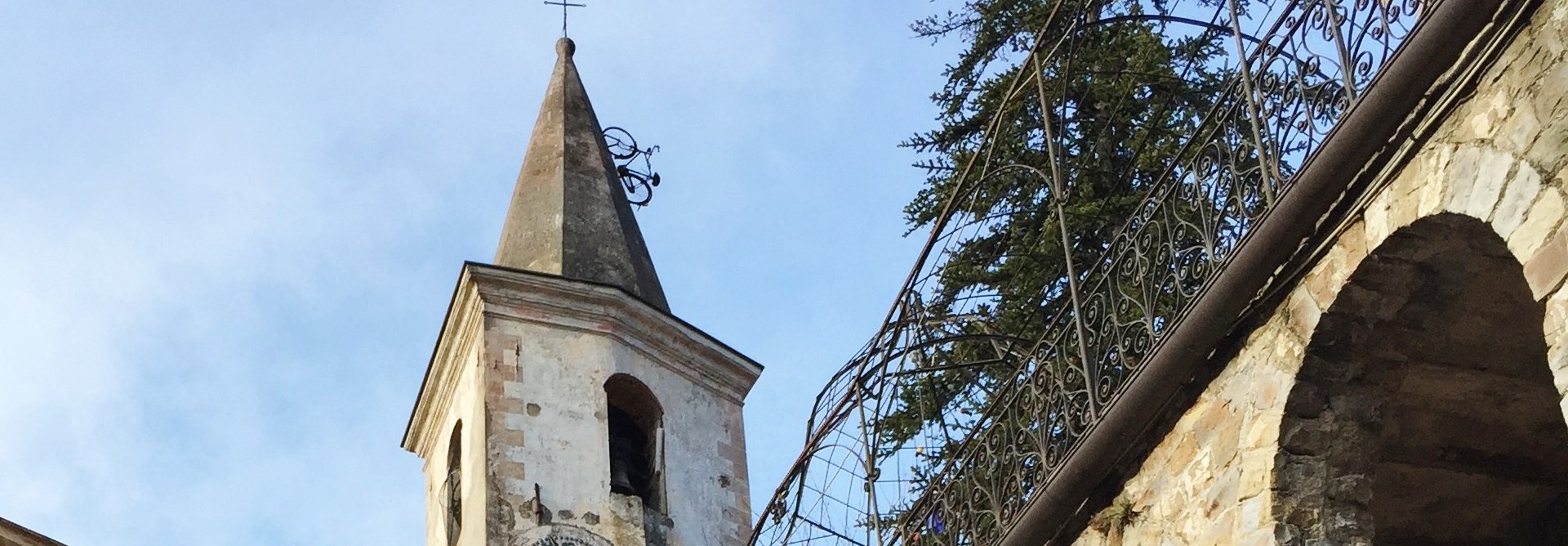
It’s not everywhere that you see a bicycle heading up the bell tower of a medieval Italian town. But Apricale in Liguria is not only “One of the Seven Most Beautiful Villages in Italy”, it is also an artists retreat and this contemporary installation by Sergio Bianco in 2000 “La forza della non Gravità” (the force of non gravity) has remained a symbol of the town and is loved by everyone.
It is no surprise that a village like Apricale with its extraordinarily beautiful position, atmosphere and medieval urban structure, which has remained practically unchanged since the mid thirteenth century, has attracted many artists who spend periods of creativity at the art atelier along with numerous Italian and foreign artists who have done the same since the fifties. This artistic tradition continues through the constant relationships with the French Riviera and with the Maeght Foundation of Saint Paul de Vence.

It was January and pretty cold when we arrived in Apricale, a bonfire was roaring in the piazza and local people were sitting and standing around the fire keeping warm and drinking copious amounts of the delicious local red wine. The townspeople had decided to keep the fire burning for several months after the Christmas celebrations because it was a lovely way to gather everyone together and drink wine and solve the worlds problems. Especially as the piazza has free wifi.
Firewood was left in a big pile and whoever went by just added some more to the fire as it was needed.
Two thousand years before Christ an ancient Ligurian people inhabited this area. ‘Apricalese’, the language spoken by young and old in Apricale today and probably many other characteristics of the current inhabitants are derived from these early Ligurians. The local agricultural know-how of wine making, pizza baking, sun drying and salting of produce will have come from the Romans, who were settled for many hundreds of years in the area.
The valley below Apricale was a route for the salt caravans which brought vast quantities of this precious commodity all the way from North Africa. The story of Apricale village itself is said to begin with salt trading Celts from Northern Europe who trod the mule tracks down through the valley to the Mediterranean.
Many hilltop villages were built across Northern Italy in the 13th and 14th centuries to protect people and their rapidly growing wealth of traded goods and livestock from bandits, predatory nobles – who governed a number of towns and cities – and wolves which roamed the hillsides around the villages.
The Comune of Apricale has records going back to 1267, with statutes from the count of Vengtimiglia, establishing it as the first independent village in Liguria, a small but independently governed community.
They very cleverly resisted the feudal lord and peasant relationships which dominated all over Europe at that time. Everyone was equal and friendly, and they still live this attitude.
The people of Apricale intended, as far as possible, to develop their own livelihoods rather than labour in support of a distant leisured class.
Over the years however, the town was seized by the Dorians and then by the Grimaldis and after WWII the Germans occupied and then destroyed parts of the town. So the community has worked hard to bring back their old town.
During the nineteenth and early twentieth centuries the population was around 2,000 but now there are just 600 permanent residents who make a living from tourism, building maintenance and working on their small agricultural holdings of mostly olives and grapes.
There are no cars in the town only ancient cobbled streets, archways, tunnels, bridges and terraces. Most of the houses have arched stone ceilings.
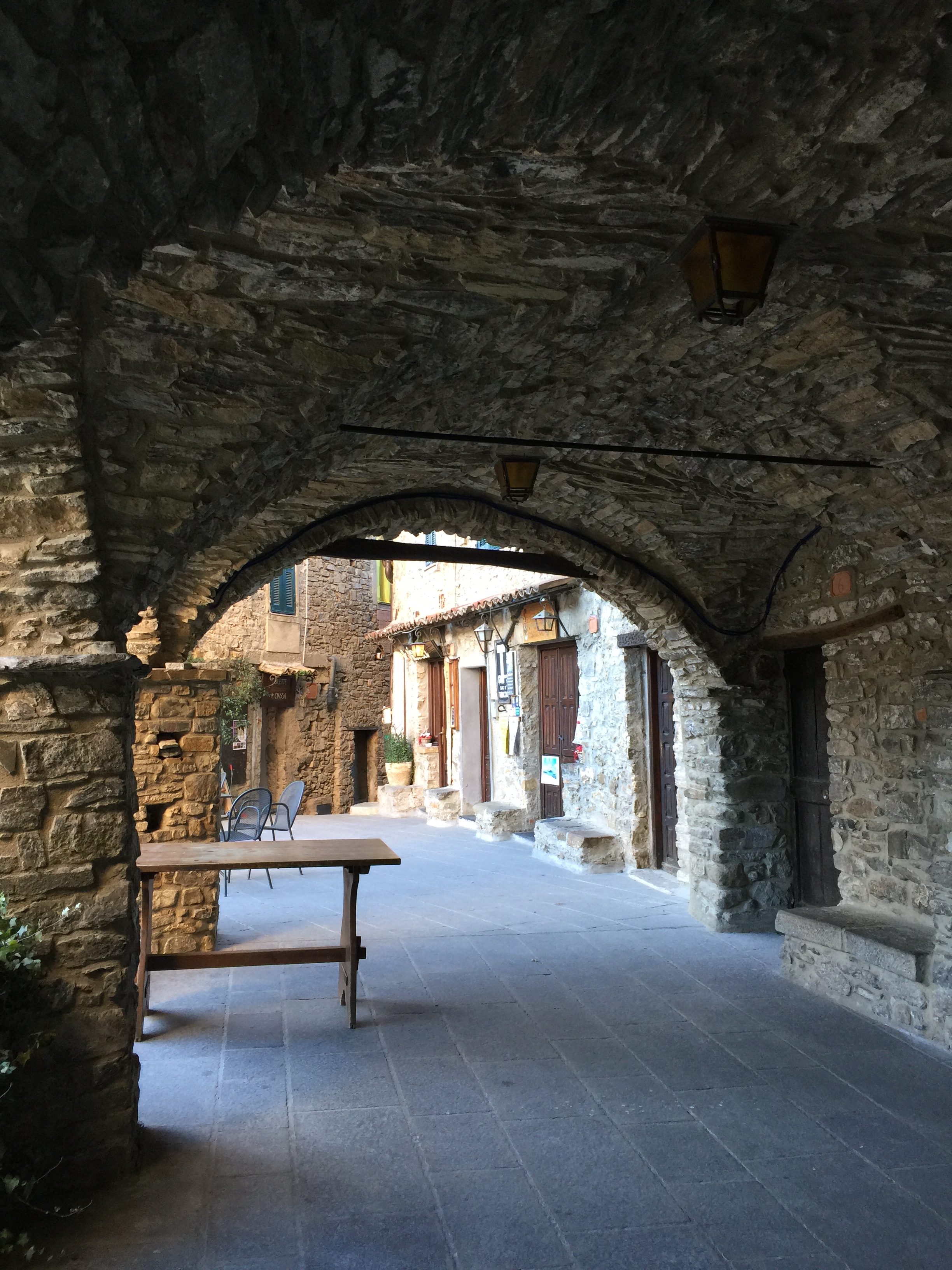
During the tourist season when the surrounding valley is covered in parked cars and tourists are climbing the hundreds of cobbled steps and slopes up to the piazza, the shops stock locally produced bread, cheese, ham, sausages, pesto, olive oil and wine.
Apricale’s seven restaurants serve great traditional meals with seasonal vegetables, salads, herbs and fruits from local gardens, chestnuts and fungi, wild boar and rabbit from the wooded hillsides and all the sun dried and oil preserved delicacies of this ancient region. Traditional festivals, religious days and dances, which have long been part of Apricale life continue and bring many of the former residents home, just as they do in Venice. Plus, the art and pottery atelier regularly holds art exhibitions, music recitals, puppet shows and plays. There are artists in residence all of the time during the warmer months and plenty of B&B’s to stay in.
Apricale has always welcomed people and has adapted to survive many times over 2,000 years!
 TRAVELS PAST & PRESENT