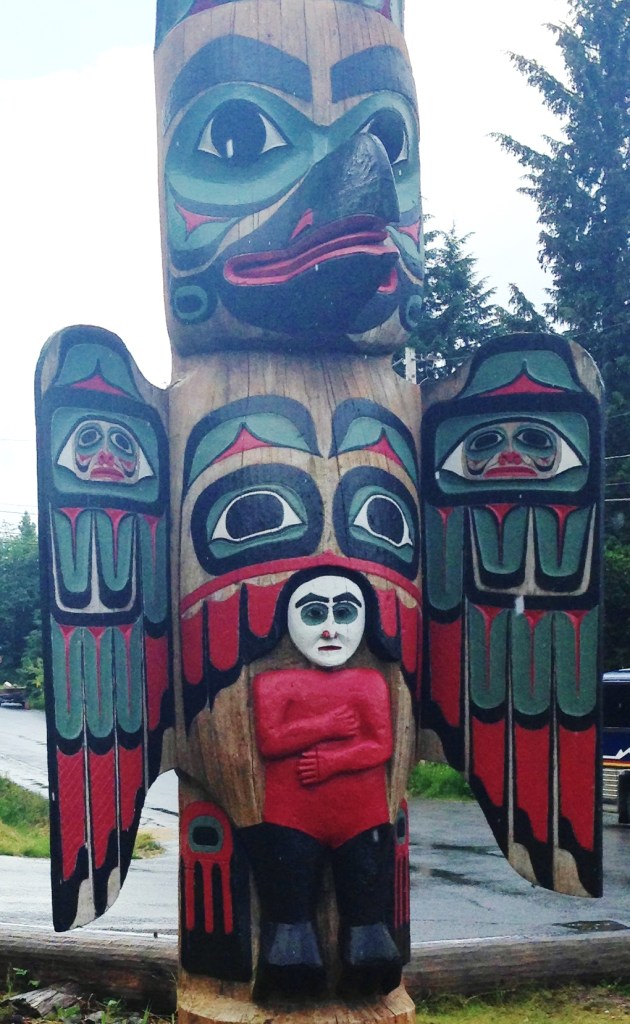
When Russia sold Alaska to the United States in 1867, both parties seemed to completely ignore the fact that a great deal of the vast region already belonged to aboriginal peoples. The Pacific Northwest Coast had the most densely populated areas of indigenous people ever recorded. The land and waters had always provided rich natural resources through timber – mostly cedar – and salmon, and many highly structured cultures had developed, each with their own distinct history, culture, and society. The Tlingit society we were introduced to in Juneau, Southern Alaska was just one of the twenty communities in the area.
The art of the Tinglit people is fascinating with large bold shapes and colours providing a tie to their land by depicting histories on totem poles, canoes, house posts, weavings, jewelry, and other art forms. The symbols depicted were a constant reminder of their matrilineal kinship, birth place, lineage and nation always illustrating how the community is divided into two main clans, the Raven and the Eagle.
The creation of beautiful and practical objects for all tribal communities served as a means of transmitting stories, history, wisdom and property from generation to generation.
Many works of art served practical purposes, such as clothing, tools, weapons of war and hunting, transportation, cooking, and shelter but others were purely aesthetic.
Salmon and giant crab fishing are still huge industries for the whole area and although seasonal, the income during the short season is substantial.
Thanks to the Klondike gold rush in the late nineteenth century, Skagway is one of the few communities in southern Alaska with a road out nowadays so you don’t have to depend on the Gulf of Alaska to get there.
The Klondike Highway was completed in 1978, it more or less follows the the old gold mining route to Dawson City the centre of the Klondike gold mining. There is a narrow gauge railway line between Skagway and Whitehorse the capital and only city of Yukon which was built to transport prospectors to the gold fields and is now a sightseeing journey owned by tourism.
We arrived in Skagway after cruising the Inside Passage from Vancouver through Ketchikan and Juneau. We were in Tlingit country and the name is a variation of a Tlingit word describing the rough seas in the Taiya Inlet which leads to Skagway and by the mythical woman who transformed herself into stone at Skagway Bay and who now causes the strong winds that blow in the bay. Women rule in this part of the world!
By the late 1890’s ships were bringing thousands of hopeful miners in to Skagway, all prepared to tackle the 500 mile journey on foot to the goldfields, transporting with them enough supplies, tools, food, clothing to keep them going for a year. They weren’t allowed into Canada otherwise.
100,000 people set out for Klondike, only 30,000 or so actually made it, and only a handful became rich. Mostly they died in poverty.
Skagway was a wild, lawless town described as “little better than a hell on earth.” Fights, prostitutes and liquor were ever-present on the streets. Rings of thieves swindled prospectors with cards and dice, the telegraph office charged five dollars to send a message anywhere in the world. Unknowing prospectors sent news to their families back home without realizing there was no telegraph service to or from Skagway. There was also a comprehensive spy network, a private militia called the Skagway Military Company, a town newspaper, a Deputy U.S. Marshal’s office all run by an array of thieves and con men who roamed about the town.
The dry, sunny weather of Skagway, unlike rainy Ketchikan and Juneau has saved the eighty or so wooden saloons and other buildings from rotting, so the town has been kept intact. Tourism will keep the town alive for most of the year, it really is like walking into a wild west movie set.
 TRAVELS PAST & PRESENT