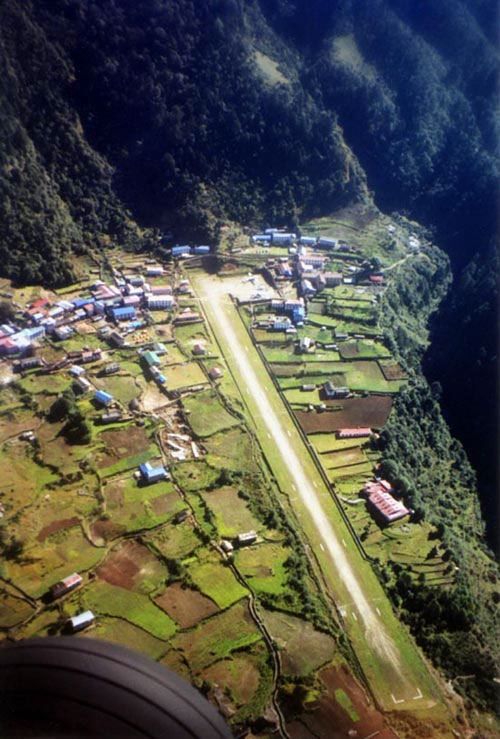
My first major trip was in 1975 to Nepal and in to the foothills of the mighty Himalayas heading towards Everest. There were no roads into the mountains and although Lukla Airstrip (Tenzing, Hillary airstrip) had been built, we wanted to trek all the way in to acclimatize to the altitude gently and then fly back out to Kathmandu.
Lukla Airstrip was built by Sir Edmund Hillary and his team of climbers and Sherpas in 1964. The aim of the strip was to make it easier to transport people and equipment into the area for the hospital, bridges, schools and water pipes that Ed was constructing, rather than the seventeen day walk carrying hundreds of loads on men’s backs.
The piece of land Ed chose was pretty rough but it was no good as arable land so the local farmers were happy to sell it.
It was at 9,000 feet, wasn’t very flat and sloped over a hundred feet from top to bottom. There was a cliff face at the top and a rather perilous drop off the bottom.
There was no mechanical equipment available, so the airstrip was built by hand, with over a hundred Sherpas wielding their kukris and mattocks cutting down bush, dynamiting or digging huge holes next to any large rocks and rolling the rocks into them. After several weeks of hard work it was time for the final touches. The strip was still too bumpy for a plane to land on. A steamroller was needed to smooth and firm up the surface.
Ed as usual came up with the perfect idea, purchasing copious quantities of the local Chung-a fermented rice concoction-he then hosted a party and before long fifty or so Sherpas were dancing up and down the 1,150 foot strip. Sherpa dancing is done in a long row with their arms around each other and a lot of heavy foot stamping backwards and forwards.
After a very convivial, foot thumping two days, the strip was ready and the first Pilatus Porter landed.
The Pilatus Porter is a STOL aircraft used where a short take-off and landing is needed. Perfect for Lukla.
When we finally arrived at the end of our four week trek, the airstrip had been in operation for ten years and had everything one needed for flying in and out from Kathmandu. That is, there was a set of scales in a little brush hut beside the runway for us to weigh our bags and ourselves on preparation for our flight. No radio but you could see a plane from a long way away as it came up the valley. Perfect!
We set up camp beside the runway and went to bed early as it would be an early start scraping snow and ice off the entire runway with branches so that when the sun hit, any remaining ice would melt quickly and the pilot would be able to see where to land. Perfect again!
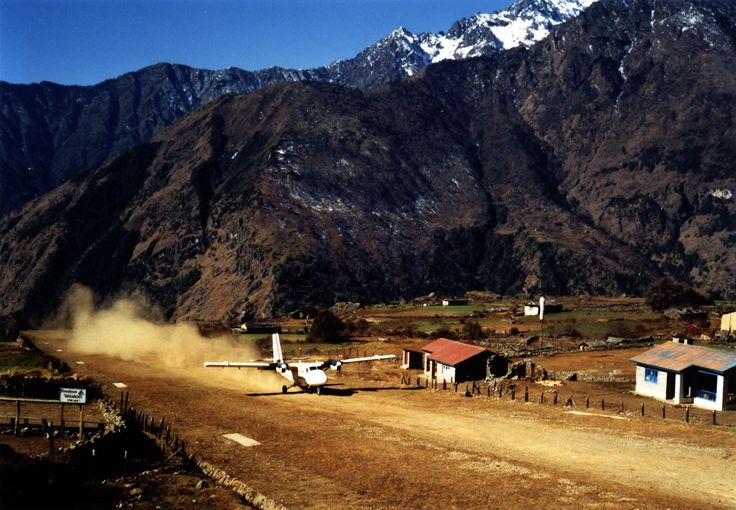
Flights would come in early in the morning when the weather was settled. Someone heard the plane coming long before we caught site of it, we ran out to shoo cattle and dogs off the runway and soon we spotted the glint of a plane in the clear morning sun.
Our Pilatus Porter landed gently on the runway needing full power to taxi up the steep slope to the top.
Everyone moved quickly to get on board so that the plane could make the return trip to pick up the rest of us before the weather closed in.
I must say, watching the plane tear down the runway and then drop off at the bottom was rather disconcerting, but after a little while you would see it gaining altitude as it headed down the valley.

